Organized byQuadam Veterinary
Addressed to Veterinarians
ABOUT THE COURSE This program will provide foundational, clinically relevant information regarding commonly encountered ophthalmic emergencies in dogs. It is designed to equip veterinary professionals with the knowledge and confidence to recognize, assess, and manage these ophthalmic emergencies. Through a focused exploration of urgent conditions affecting the orbit, adnexa, cornea, and intraocular structures, participants will learn to rapidly identify sight-threatening problems and initiate appropriate interventions. Emphasis will be placed on conditions that are reasonable to manage in practice and when referral should be initiated, if available. The curriculum covers a wide range of critical topics, including orbital and adnexal emergencies such as proptosis and eyelid trauma, corneal ulcers and perforations, acute glaucoma, anterior and posterior lens luxations, and the diagnostic approach to sudden blindness. By the end of the course, learners will be better prepared to stabilize patients, prioritize differential diagnoses, and make timely decisions that preserve comfort and vision. This program is ideal for primary care general practice and emergency veterinarians seeking to strengthen their emergency ophthalmology skills and improve outcomes for canine patients.
PROGRAM Approved for 18 hours of continuing education. RACE Program Number: 20-1384642
WEEK 1: Orbital & Adnexal Emergencies
WEEK 2: Corneal Emergencies
WEEK 3: Glaucoma
WEEK 4: Lens Luxation
WEEK 5: Sudden Blindness
WEEK 6: Case studies
Throughout the course, Dr. Meekins will answer participants’ questions and present numerous clinical scenarios for discussion.
LEARNING OBJECTIVES
By the end of this course, participants will be able to:
• Recognize and differentiate common orbital and adnexal emergencies in dogs, including proptosis, eyelid trauma, and orbital abscessation or cellulitis, and determine appropriate stabilization steps.
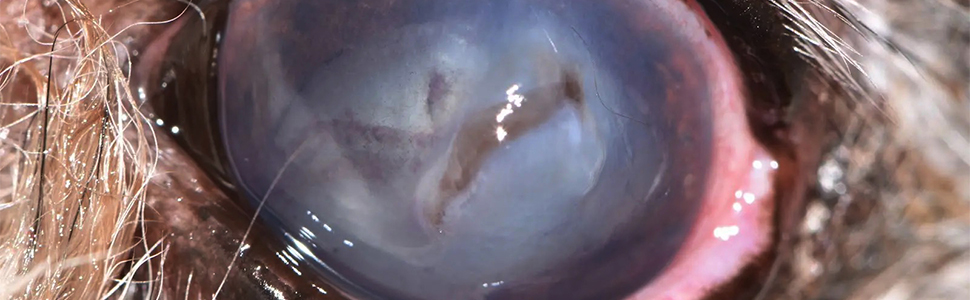
• Assess and triage corneal emergencies such as lacerations, deep ulcers, descemetoceles, and perforations, using diagnostic tools to guide urgent treatment decisions.
• Identify clinical signs of acute glaucoma, perform rapid diagnostic evaluation, and initiate interventions to reduce intraocular pressure and preserve vision.
• Diagnose lens luxations, distinguish them from other causes of acute ocular pain or vision loss, and select appropriate medical or surgical management strategies.
• Develop a systematic approach to sudden blindness, integrating neuro-ophthalmic examination findings to localize lesions and prioritize differential diagnoses.
• Implement emergency treatment protocols that stabilize ocular structures, relieve pain, and prevent further damage while preparing patients for referral or advanced care.
• Communicate effectively with pet owners about prognosis, urgency, and treatment options for ophthalmic emergencies, supporting informed decision-making and advocating for referral when available and indicated.
THIS COURSE IS NOT A WEBINAR NOR SCHEDULED AT SPECIFIC TIME
This course includes a practical and flexible syllabi so that you can follow the lessons, exams and activities at your own pace. It offers great time flexibility allowing you to join the tutor any time at your convenience: as many times and how you desire.
This practice-oriented course will offer a series of audiovisual lessons and exams. Between the lessons the tutor will be available in interactive sessions, where learning is further optimized through questions/answers, forum, case discussions, quizzes, and much more (all the course material will belong to you for a minimum of one additional year). You also will have the opportunity to interact with other veterinarians. Unlike other forms of e-learning, this online course offers a high level of interaction between students and with the tutor.
THE LEARNING METHOD:
1. Constant presence of the teacher during the entire duration of the course, and available to answer any questions raised by the students. Besides, the teacher sets different interactive activities for the students.
2. The course is attended simultaneously by all students. Enhancing students’ sharing and participatory experience is a Quadam hallmark.
3. All lessons are audiovisual and available at any time.